Monday, October 19, 2026

* All product/brand names, logos, and trademarks are property of their respective owners.
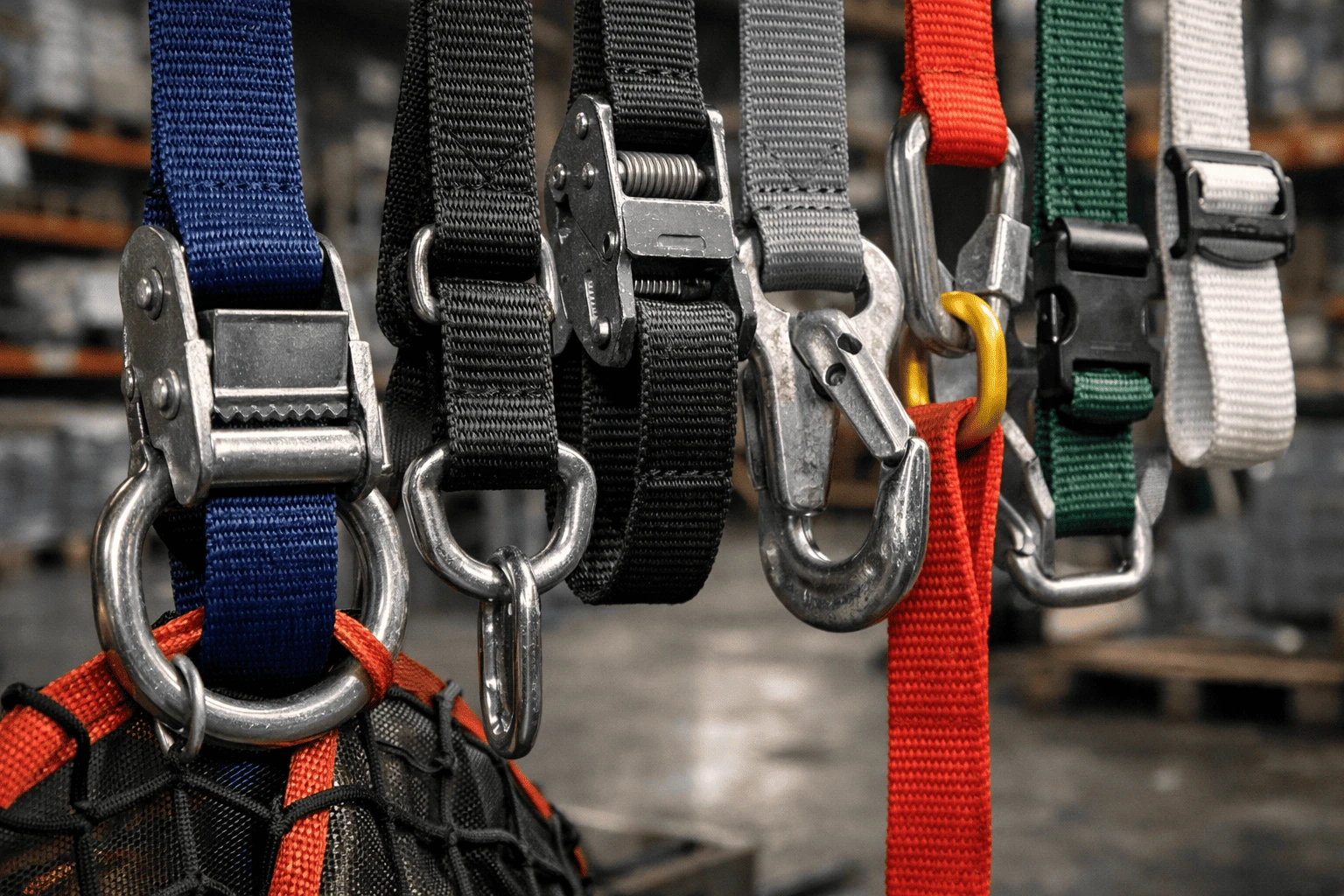
Industrial accessories rarely fail because of one dramatic mistake. More often, performance declines gradually—through daily wear, repeated tension, friction against hardware, or materials that were never fully suited to the task. That’s why nylon webbing remains widely used across UK industrial environments. When selected carefully, it offers a practical balance of strength, flexibility, and repeatable performance.However, nylon webbing is not a one-size-fits-all solution. The right choice depends on how the accessory will function, how often it will be adjusted, the level of load or tension involved, and the environment it operates in. This guide outlines the key considerations that matter most for industrial projects and explains when a general nylon option or a standard 25mm format may be appropriate.
Choosing webbing for industrial use is fundamentally about reducing risk. Not just the risk of sudden failure, but the slower risks—fraying edges, gradual stretching, inconsistent fit, and fatigue that appears after months of use rather than days.
Durability in industrial contexts extends beyond simple breaking strength. It includes how the webbing performs after repeated handling and constant exposure to mechanical stress.
Tensile strength (pulling force):
If an accessory sits under tension or experiences regular pulling, the webbing must hold its shape and maintain predictable behaviour. Nylon is commonly selected because it combines strength with controlled flexibility, allowing it to absorb strain without becoming rigid.
Abrasion resistance (friction and surface contact):
In real-world industrial environments, webbing interacts continuously with hardware—metal fittings, buckles, guides, and edges. Friction is one of the leading causes of early wear. A weave that resists abrasion helps maintain structural integrity and reduces edge fraying over time.
Long-term wear (repeat handling cycles):
Industrial accessories are rarely static. They are tightened, released, repositioned, and stored repeatedly. Over time, lower-quality webbing may thin in high-contact areas or become uneven. Even if it does not break, inconsistency can affect performance and safety. A practical takeaway: evaluate durability holistically. Abrasion resistance and consistency across repeated use often matter as much as headline tensile figures.
UK industrial settings frequently involve mixed indoor and outdoor conditions—loading bays, unheated units, damp storage spaces, and fluctuating temperatures. These factors influence how webbing behaves.
Moisture exposure:
Even partial dampness can affect long-term wear, particularly when grit or dust becomes embedded in fibres. When webbing runs through fittings with trapped debris, abrasion accelerates.
Temperature variation:
Moving between colder and warmer areas can change how materials feel and flex. Consistency in weave and construction helps maintain predictable handling across these transitions.
Dust and contamination:
Fine particles act like abrasive compounds when compressed against hardware. Regular inspection reduces the risk of unnoticed thinning.A simple preventive step is to include quick visual checks during routine handling. Watch for edge fraying, fuzzing, thinning at contact points, and areas where the weave feels softer than surrounding sections. Early identification prevents disruption later.
In industrial environments, repeatability is part of quality. If a webbing performs well today but varies significantly in the next batch, assembly processes and outcomes may be affected.
Procurement teams typically prioritise:
Consistency across batches:
Uniform thickness, weave density, and finish support predictable assembly and reduce adjustments during stitching or hardware fitting.
Clear product information:
Accurate specifications simplify reordering and reduce confusion across teams.
Reliable availability:
When projects grow, consistent availability matters as much as performance. Nylon Webbing is widely used as a durable material for industrial applications, offering repeated handling and versatile use. Careful review of specifications helps ensure it meets your operational requirements.
After considering durability and environmental factors, selection often comes down to how accessories are built and standardised within your operation.
A general nylon webbing option is suitable when projects vary in size, hardware configuration, or finishing method. It offers adaptability while maintaining dependable material characteristics.
This approach may work well when:
Multiple accessory types are produced within the same facility
Lengths and attachment methods differ across projects
A balance of strength and handling flexibility is required
Adaptable materials simplify planning when workflows change frequently. Maintaining a consistent nylon base material reduces the need for multiple stock types while supporting varied builds.
For projects built around repeatable specifications, a defined 25mm format can support structured assembly workflows. The 25mm Strong & Secure Nylon Webbing Dark Blue Tape format provides a uniform width that aligns with standardised processes.
The practical advantages of a consistent 25mm specification include:
Reduced twisting during installation
Easier alignment when stitching
Predictable feeding through hardware
The dark blue colour can also assist with material identification in environments where multiple components are handled simultaneously. While colour does not change mechanical properties, visual differentiation can help streamline inspections and reduce mix-ups.A grounded way to assess suitability is to review how often your builds repeat the same measurements. If identical widths are required across batches, standardisation can reduce minor assembly inconsistencies that accumulate over time.
Cost decisions should consider the full service life of the accessory, not just initial purchase price. Replacement labour, downtime, and inspection frequency all influence total expenditure.
A balanced procurement approach may involve:
Matching material to wear pattern:
High-contact accessories benefit from webbing that maintains structure under repeated friction and tension.
Standardising where practical:
Using a consistent width such as 25mm across multiple builds can simplify stocking and reduce assembly errors.
Retaining flexibility:
Keeping a general nylon option available ensures adaptability when projects vary.
A simple framework for decision-making:
Variable builds and broader applications → General Nylon Webbing
Repeatable builds requiring uniform sizing → 25mm formatThe goal is to align material selection with real operating conditions rather than defaulting to the highest strength specification available.
Choosing nylon webbing involves assessing not only strength but also environmental performance, abrasion resistance, and consistency during repeated use. Standardized options, such as 25mm formats, can support predictable performance. More detailed specifications and comparisons can be explored at straptapes.co.uk.

Finn a writer who enjoys creating simple, expressive, and engaging content. I like turning everyday ideas into clear and meaningful writing that feels natural, fresh, and easy for readers to connect with.
Oil spills in outdoor and marine environments can cause environmental damage, safety risks, and cost
30 May 2026
In today’s digital-first world, mobile applications are no longer a luxury. They are a necessi
13 May 2026
Industrial magnets play a critical role in modern industry, supporting a wide range of applications
5 February 2026
Be the first to share your thoughts
No comments yet. Be the first to comment!
Share your thoughts and join the discussion below.


.webp&w=3840&q=75)