Monday, October 19, 2026
* All product/brand names, logos, and trademarks are property of their respective owners.
Efficiency is a key consideration in today’s industrial environments across the UK. From manufacturing floors to warehouses and control rooms, the ability to install, adjust, and maintain systems smoothly affects productivity, safety, and long-term costs. Traditional fasteners like screws, bolts, and single-use cable ties work well for permanent setups, but they can slow down routine access and maintenance, creating waste and potential damage over time. Hook and loop fasteners provide a practical alternative, offering a balance between secure attachment and easy removal. This article looks at how these fasteners support quicker maintenance, adaptability, and smoother operations.
In industrial environments, slow installations rarely impact just one task. Small delays can ripple across operations, lengthening maintenance windows and reducing overall output. Even minor inefficiencies, repeated across multiple sites or over time, can add up to noticeable operational and financial strain.
A major factor behind these slowdowns is the reliance on permanent or single-use fasteners. Plastic cable ties, for instance, must be cut away during inspections or upgrades and then replaced. This adds extra steps to routine work and increases material use, which over time becomes costly. Labour efficiency is equally important. Maintenance teams may spend considerable time removing fixings, handling tools, and reassembling components instead of focusing on troubleshooting or improvements. In high-pressure settings, this can lead to rushed work or temporary fixes that affect organisation and safety.
Downtime is the most obvious consequence. When panels, cable routes, or guards are hard to access, inspections take longer, and production schedules can slip. Streamlining access is therefore both a practical and strategic advantage.
Hook and loop fasteners are particularly effective in environments where maintenance and change are ongoing rather than occasional. Their design allows repeated use without significant loss of performance, making them ideal for cyclical tasks.
Maintenance work often involves accessing cables, panels, or equipment housed in confined spaces. Fasteners that require cutting or unscrewing can slow this process considerably. Hook and loop solutions enable components to be released quickly without tools, allowing inspections and repairs to begin sooner. In cable management applications, reusable hook and loop cable ties are commonly used to secure wiring while still allowing easy release for re-routing or fault-finding. This reduces handling time and helps protect cables from abrasion or over-tightening.
Single-use fasteners introduce waste every time they are removed. Hook and loop fasteners are designed for repeated opening and closing, significantly reducing material consumption. This is particularly beneficial in large facilities where maintenance tasks are frequent. Back-to-back grip straps can be cut to length and reused across multiple applications. Their adaptability makes them suitable for bundling cables, hoses, or temporary components during servicing, without the need for constant replacement.
Efficient fastening methods have a direct impact on workflow. Adhesive-backed hook and loop tapes and squares allow components to be fixed quickly to suitable surfaces without drilling or surface modification. This is especially useful for temporary covers or modular fixtures that need to be removed and refitted regularly. By reducing the steps required to secure and release components, maintenance teams can work more fluidly, reducing interruptions and keeping equipment operational for longer periods.
The advantages of hook and loop fasteners become most apparent when applied to tasks that require regular adjustment or access. Several common industrial applications highlight their value.
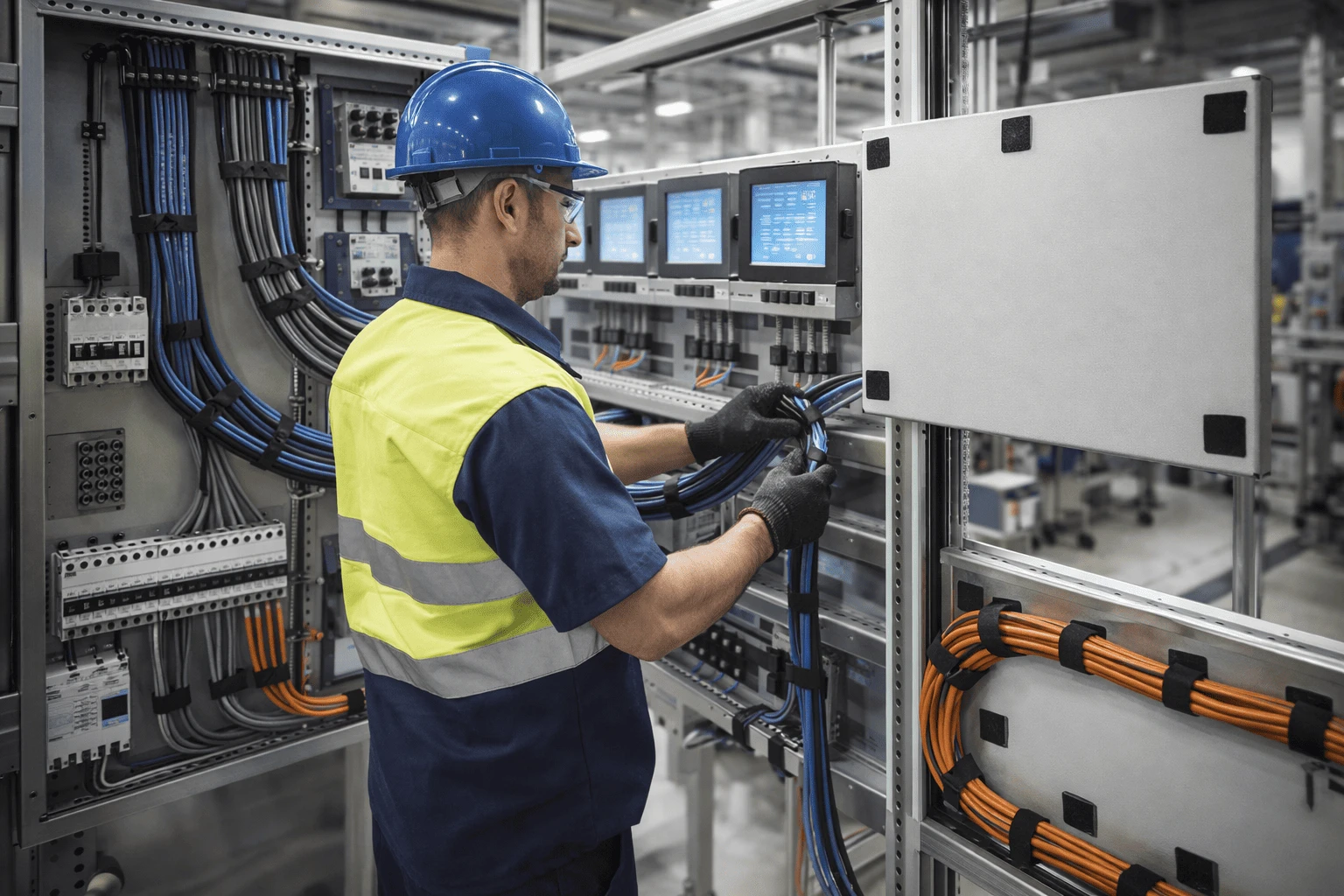
Control panels and machinery enclosures often evolve as systems are upgraded or expanded. Traditional cable ties can make these changes cumbersome, as they must be cut and replaced during every modification. Reusable hook-and-loop cable management solutions allow cables to be bundled securely while remaining easy to release. This supports cleaner layouts, faster upgrades, and more efficient troubleshooting, particularly in complex installations.
Industrial environments frequently rely on temporary or removable panels to protect components while still allowing access. Drilling or permanent fixings are not always practical, especially when panels need to be removed repeatedly. High-tack adhesive hook-and-loop tapes or squares provide a strong yet flexible method for securing lightweight panels and guards. They allow for quick removal during inspections and easy reattachment once work is complete.
Clear signage and labelling are important for safety and operational clarity, but industrial layouts often change over time. As workflows evolve or new equipment is added, signs may need to be repositioned. Using a Hook & Loop Fastener provides a flexible solution for mounting labels and signs, allowing adjustments without damaging surfaces. This type of fastening material is well-suited for applications that require repeated access or updates, supporting adaptable and organised environments without compromising reliability
Not all hook and loop fasteners are the same, and selecting the right type is essential for consistent performance.
Adhesive-backed fasteners are well-suited to hard, smooth surfaces where quick installation is required. They are commonly used for signage, access panels, and lightweight fixtures. High-tack adhesives provide reliable bonding when surfaces are properly prepared. Sew-on hook and loop tapes are more appropriate for applications involving fabrics or flexible materials, or where repeated movement is a factor. These are often used in protective covers or industrial textile applications where adhesives may not perform as well over time.
The format of the fastener should align with the task. Grip straps are ideal for bundling and securing items that vary in size, such as cables or hoses. Coins and squares are better suited to point fixing, while tapes provide continuous contact along larger surfaces. Understanding these differences helps ensure the fastener supports both load requirements and ease of use.
Colour can be a practical consideration in industrial environments. Black fasteners are often used in machinery and control panels, while white options are preferred in clean or high-visibility areas. Surface compatibility is equally important. Clean, dry surfaces maximise adhesive performance, and selecting the appropriate strength ensures reliability without over-engineering the solution.
The long-term benefits of hook and loop fasteners extend beyond immediate installation speed. Over time, they contribute to more efficient operations in several key ways:
Reusable fasteners reduce the need for ongoing replacement, lowering consumable costs and supporting waste reduction efforts.
Their adaptability allows businesses to respond more quickly to layout changes or equipment upgrades, minimising disruption.
Improved organisation contributes to safer workspaces and easier inspections, supporting compliance and reducing the risk of accidents.
Collectively, these advantages make hook and loop fasteners a practical choice for businesses looking to improve efficiency without adding complexity.
Hook and loop fasteners play a valuable role in enhancing efficiency across industrial installations. By supporting faster access, reusability, and adaptability, they help reduce downtime, streamline maintenance workflows, and maintain organised, flexible environments that evolve with operational needs. More insights and resources on industrial materials and fastening solutions are available at industrialmaterial.uk.

I am Oliver, a blog writer who enjoys creating clear, engaging, and meaningful content for readers. I like exploring different topics and turning ideas into simple, easy-to-understand articles that provide real value. My focus is on writing in a natural and creative way so readers can stay interested and connected. Through my blogs, I aim to inform, inspire, and share useful insights with my audience.
When building a solar power system, choose every part carefully. The solar cable needs special atten
22 September 2026
The selection of the correct diesel injector system goes beyond technology. It has a direct effect o
18 August 2026
In industrial settings, webbing is one of those “small” components that quietly holds ev
19 February 2026
Be the first to share your thoughts
No comments yet. Be the first to comment!
Share your thoughts and join the discussion below.



.webp&w=3840&q=75)