Saturday, October 10, 2026
* All product/brand names, logos, and trademarks are property of their respective owners.
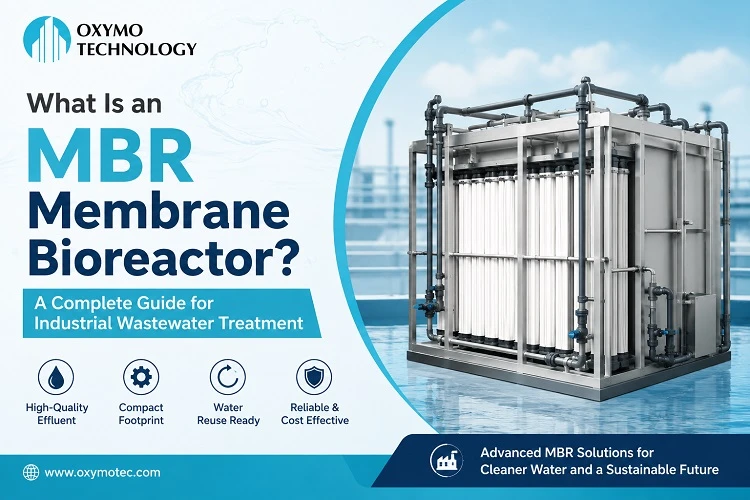
Managing industrial wastewater is becoming more challenging. Discharge regulations are getting stricter, water costs continue to rise, and many facilities have limited space for expanding treatment infrastructure. As a result, more manufacturers are turning to MBR membrane bioreactor technology as a practical way to improve treatment performance while making better use of available space.
The MBR membrane bioreactor is a combined system of two treatment processes: biological treatment and membrane filtration, in one compact solution. It is a system designed to separate treated water from solids, bacteria, and suspended matter without gravity settling in a large secondary clarifier, using ultrafiltration membranes.
This integrated design eliminates the need for a secondary clarifier and, in many cases, a sand filter. The result is better effluent quality, a smaller treatment footprint, and treated water that can often be reused in industrial applications.
For industrial facilities, this means a treatment system that delivers consistent effluent quality while reducing the number of process units. It also provides greater flexibility when upgrading existing plants where space is limited or production capacity needs to increase.
Although configurations differ between manufacturers, every MBR membrane bioreactor is similar in operation to the others:
Biological breakdown: Microorganisms in the bioreactor break down organic pollutants, as in a standard activated sludge process, but at much higher biomass concentrations.
Membrane filtration: Mixed liquor is filtered through hollow-fibre or flat-sheet membranes, with water passing through while solids and pathogens remain on the membranes.
Continuous aeration: Air is pumped across the membrane surface to prevent fouling and provide oxygen for the biology.
Clean effluent output: Treated water is discharged or reused at a sufficiently high quality, with no need for further polishing.
The MBR system can use a much higher biomass concentration than conventional plants because the membrane physically retains biomass. That is the primary reason why they occupy less space.
Industrial wastewater treatment presents different challenges than municipal applications. Wastewater quality can change from one production cycle to the next, treatment requirements vary by industry, and unexpected downtime can be costly. MBR technology helps facilities manage these challenges while maintaining reliable treatment performance.
Superior effluent quality: Membrane filtration technology removes both suspended solids and pathogens much better than gravity settling.
Smaller footprint: Higher biomass concentrations enable a smaller bioreactor to treat the same wastewater volume, making MBR systems ideal for installations with limited space.
Tolerates variable loads: MBR systems can cope with fluctuations in organic load and composition found in food, dairy, textile, pharmaceutical and chemical wastewater.
Water reuse ready: Many plants recycle MBR effluent for process water, irrigation, or cooling, reducing water bills and discharge volumes.
Supports future expansion: Many facilities choose MBR systems because additional treatment capacity can often be added more easily than with conventional treatment processes, reducing the need for major plant modifications.
Fewer process units: The absence of a secondary clarifier and sand filter reduces the number of maintenance units and failure points.
|
Factor |
Conventional Activated Sludge |
MBR Membrane Bioreactor |
|
Solids separation |
Gravity settling in a clarifier |
Membrane barrier (ultrafiltration) |
|
Footprint |
Large |
Compact |
|
Effluent quality |
Moderate, often needs polishing |
High, reuse ready |
|
Sand filter needed |
Usually |
No |
|
Sludge bulking risk |
High |
Low |
MBR technology has been found in a variety of industrial wastewater treatment applications such as:
Food and beverages processing
Dairy production
Textile, printing and dyeing
Pharmaceutical manufacturing
Chemical processing
Oilfield and papermaking wastewater
Every industrial wastewater stream has its own treatment challenges. Factors such as organic load, suspended solids, chemical composition, and daily flow variations all influence system design. An MBR membrane bioreactor can be engineered to meet these requirements, making it suitable for both new treatment facilities and upgrades to existing plants.
Choosing the right MBR membrane bioreactor manufacturer is about more than selecting the equipment itself. Membrane quality, engineering expertise, technical support, and long-term reliability all play an important role in overall system performance.
Reinforced membranes: PVDF membranes are more resistant to fouling and chemical degradation than inferior membranes.
Manufacturing standards: Look for manufacturers certified to ISO 9001, ISO 14001 and CE certification.
Customisation and OEM support: it is rare to find an industrial project that is the standard module size, so custom engineering is important.
After-sales support: Installation guidelines, commissioning assistance, and ongoing maintenance support make the difference between a real manufacturer and a reseller.
Proven industrial experience: Look for a manufacturer with experience across different industries and wastewater applications. This often leads to better system design and smoother project implementation.
Manufacturers that design and produce their own membranes typically have greater control over product quality, performance, and long-term technical support than suppliers that simply rebrand third-party products.
Finding the right MBR membrane bioreactor manufacturer in the USA requires looking beyond the equipment itself. Consider membrane quality, manufacturing standards, customization capabilities, technical support, and long-term reliability before making a decision. A trusted manufacturer not only delivers a dependable wastewater treatment solution but also becomes a reliable partner as your operational needs continue to grow.
Whether you are expanding an industrial facility, upgrading an existing treatment plant, or planning a new project, Investing in a well-designed MBR membrane bioreactor is about more than meeting today's treatment requirements. It can help reduce operating costs, support water reuse initiatives, simplify future plant expansion, and provide reliable performance as production demands change.
What is the main advantage of an MBR membrane bioreactor over conventional treatment?
The biggest advantage is the combination of water quality and space savings. Membrane filtration removes far more solids and pathogens than gravity settling, and the compact system design occupies a much smaller footprint than a conventional treatment plant.
How long do MBR membranes typically last?
Reinforced PVDF membranes generally last 5 to 8 years under normal operating conditions with proper maintenance.
Can MBR systems handle industrial wastewater with variable composition?
Yes. This is one of the technology's biggest strengths. MBR systems tolerate fluctuating organic loads better than conventional activated sludge processes, making them well-suited to industries such as food processing, dairy, and chemical manufacturing.
Is MBR-treated water safe for reuse?
In most cases, yes. The ultrafiltration grade barrier produces effluent clean enough for irrigation, cooling, process reuse, and other non-potable applications, subject to local regulations.
When space is limited, discharge limits are tightening, or water costs are increasing, an MBR membrane bioreactor in the USA may offer multiple solutions to one problem. Every industrial wastewater project has different requirements. Whether you're designing a new treatment facility, expanding production capacity, or upgrading an existing plant, choosing the right MBR system starts with understanding your wastewater characteristics and treatment goals. Our team works closely with engineers, contractors, and industrial operators to recommend solutions that match your operational requirements and long-term objectives.

I’m a positive and ambitious person who enjoys learning new things, meeting people, and growing through every experience. I value honesty, confidence, and keeping a balanced outlook in life.
Choosing the right custom busbar manufacturer is not just about price and delivery times. Custom bus
3 September 2026
When you're looking for exterior cladding options for a business building, you may have heard the te
20 August 2026
You may walk past any flagship store today and see the glass is doing something it never used to do.
12 August 2026
Be the first to share your thoughts
No comments yet. Be the first to comment!
Share your thoughts and join the discussion below.





.webp&w=3840&q=75)