Saturday, October 10, 2026

* All product/brand names, logos, and trademarks are property of their respective owners.
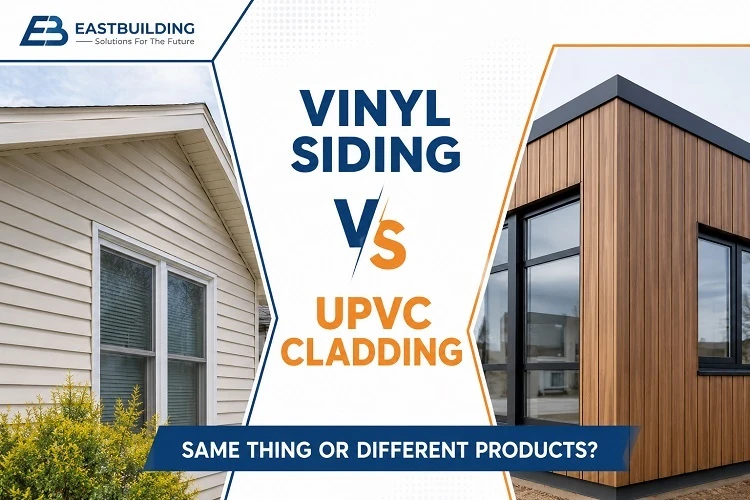
When you're looking for exterior cladding options for a business building, you may have heard the terms vinyl siding and UPVC cladding. If you're wondering whether they are the same or if there are two entirely different products, you're not alone.
The confusion is understandable. They are both PVC-based materials. Both are used to defend the construction from the elements. And both appear alike at first glance. However, they're not the same, and picking the wrong one can cost you time, money, and headaches down the line.
This blog explains exactly how vinyl siding will differ from UPVC cladding, where they both intersect, and how to make the right choice for your next commercial project.
Vinyl siding is an exterior cladding product that originated in North America in the 1950s. It was designed as a low-cost, low-maintenance alternative to wood and aluminum cladding for residential and commercial buildings.
It's made from PVC (polyvinyl chloride) compounded with other additives — including UV stabilizers, impact modifiers, and pigments. This provides flexibility, service, and a variety of colors. Usually, vinyl siding is installed in long horizontal panels, which are overlapped when installed to provide a neat, layered exterior finish.
Key features of vinyl siding include:
Available in a wide variety of profiles and colours
Resistant to moisture, rot, and insects
Lightweight and easy to install
Very low maintenance — no painting required
Cost-effective for large surface areas
UPVC is unplasticized polyvinyl chloride. The 'unplasticized' part is the key difference from standard PVC. It is the process of manufacturing without the use of plasticizers, resulting in a harder, stiffer, and more rigid PVC than conventional PVC.
UPVC cladding is popular for both residential and commercial properties throughout the UK and Europe. It's made from the same material as UPVC windows and doors, and that's why it is so durable and weatherproof.
UPVC cladding panels are designed to interlock during installation. They form a tight, waterproof, and windproof outer surface, which repels water, wind, and cold air extremely well.
Key features of UPVC cladding include:
Rigid and impact-resistant structure
Excellent thermal and acoustic insulation properties
Fire-retardant options available
Grain, smooth, and foiled finishes are available
Long life span — typically 40-50 years with low maintenance
Here's a quick comparison to help you understand how these two products stack up side by side:
|
Factor |
Vinyl Siding |
UPVC Cladding |
|
Origin |
North America |
Europe (UK/EU) |
|
Material |
PVC-based composite |
Unplasticized PVC |
|
Primary Use |
Exterior wall cladding |
Cladding, windows, doors |
|
Installation Style |
Horizontal overlapping panels |
Interlocking panels |
|
Colour Options |
Pre-painted, many shades |
Painted or foiled finish |
|
Durability |
25–40 years |
30–50 years |
|
Maintenance |
Very low |
Very low |
|
Cost |
Generally lower |
Slightly higher |
So, although vinyl siding and UPVC cladding are two different products, they do have some similarities, which is what makes it so confusing.
Both products:
Do not use lead-based stabilizers in their modern formulations
Excellent resistance to moisture & rot
Do not need much upkeep
Are lightweight compared to timber or metal cladding
Come in a range of colours and finishes
Are suitable for both commercial and residential use
In some markets, the two terms have been interchangeable, especially in North America. However, there is a clear difference in the UK and European construction industries. UPVC cladding is the most commonly used material, but vinyl siding is more precisely used for overlapping horizontal panels in North America.
The right choice will be determined by your project needs, location, and budget. Let's take the easy approach:
Choose Vinyl Siding If:
You prefer a traditional horizontal panel design.
Your priority is to be cost-efficient.
You have a large project with a limited budget
The building is in a moderate climate.
Choose UPVC Cladding If:
Maximum rigidity and structural strength are required.
The building is exposed to harsh weather conditions
You desire maximum insulating capabilities.
You must have a product that complies with UK or EU building regulations
You want it to last and last and last and last and last.
In the UK, UPVC cladding is the preferred material in most commercial buildings. It is built to local building standards, it works well in colder, wetter climates, and it is usually warrantied for longer periods.
Both vinyl siding and UPVC cladding have many advantages over traditional materials such as brick, wood, or metal, whatever you choose:
Unlike timber, there's no need for regular painting or sealing. The exterior can be washed once or twice a year and maintained in good condition.
Vinyl siding and UPVC cladding are designed to resist warping, cracking, fading, rain, wind, and temperature changes.
Both products have a lightweight characteristic, which results in quick and economical installation as opposed to heavier materials such as stone or metal composite panels.
These are sold in dozens of colors, textures, and profiles – from modern, smooth finishes right down to woodgrain effects!
Vinyl siding and UPVC cladding are two things with the same DNA, but they're designed to meet different markets and different needs. Vinyl siding is a cost-effective, highly flexible material that has been widely used in North American construction. UPVC cladding, meanwhile, provides more rigidity, durability, and adherence to UK and European building codes.
UPVC cladding is typically the wiser investment when performance, longevity, and regulation are paramount for commercial building projects. However, vinyl siding can be a good choice for projects that prioritize a budget-friendly finish over a pristine and easy-to-maintain look.
Looking for the perfect exterior cladding solution for your commercial project? Connect with Haining East Building Materials Co., Ltd. today. Our team of specialists can help you choose between vinyl siding, UPVC cladding, and other premium exterior solutions — all tailored to your building's needs and budget. Get in touch and let's build something that lasts.
No, both are made of PVC, but UPVC cladding is stiffer and tougher. Vinyl siding is primarily used in North America, and UPVC cladding is widely used in the UK and Europe.
The rigid structure of UPVC cladding means it tends to last longer: approximately 30-50 years. Typically, vinyl siding will endure for 25–40 years if cared for appropriately.
Yes, the cladding of UPVC is used in commercial buildings, as it is highly durable, weatherproof, and does not need much maintenance over time.
PVC is flexible and softer due to the presence of plasticizers, whereas UPVC is unplasticized, stronger, and is better suited to use for exterior cladding applications.

I’m a positive and ambitious person who enjoys learning new things, meeting people, and growing through every experience. I value honesty, confidence, and keeping a balanced outlook in life.
Choosing the right custom busbar manufacturer is not just about price and delivery times. Custom bus
3 September 2026
You may walk past any flagship store today and see the glass is doing something it never used to do.
12 August 2026
Managing industrial wastewater is becoming more challenging. Discharge regulations are getting stric
11 August 2026
Be the first to share your thoughts
No comments yet. Be the first to comment!
Share your thoughts and join the discussion below.





.webp&w=3840&q=75)