Saturday, October 10, 2026

* All product/brand names, logos, and trademarks are property of their respective owners.
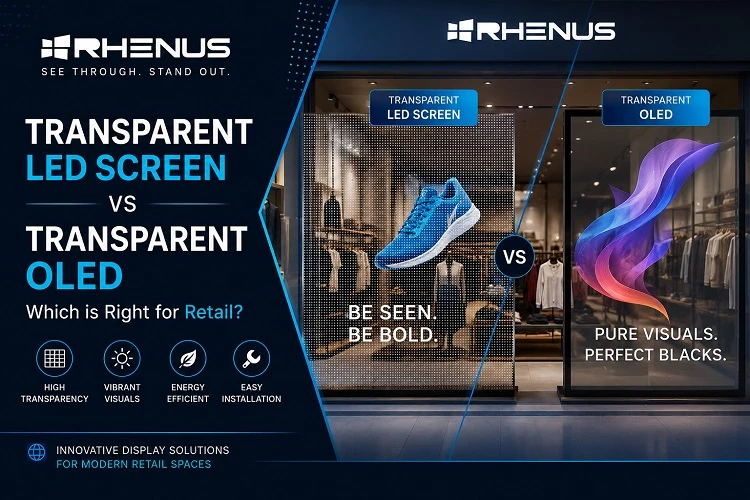
You may walk past any flagship store today and see the glass is doing something it never used to do. Glass is creatively used to show product footage, animated graphics, or a live feed. All of this happens without blocking the visual of the stores for the shoppers. They can see straight through the glass and browse the shelves. It is transparent display technology, which is the most requested feature in retail design briefs.
But transparent display is not one product. It is two very different technologies competing for the same window space. The gap between transparent LED and transparent OLED is quite a lot, and retailers only realise it after they start comparing the quotes. This guide explains how each technology works and where each one wins. It will help you choose the right one for a storefront, a flagship, or a mall installation.
Transparent LED screens are built from LED modules mounted on a mesh or PCB structure with gaps between the diodes. This allows the light and sightlines to pass through the space around each pixel. Transparent OLED panels work on a completely different principle. Every pixel is an individual light-emitting diode, which is built directly into glass. They have no backlight or mesh structure at all.
The result is that transparent LED is modular, scalable, and built for large surfaces. Transparent OLED is a fixed-size glass panel, which is suitable for smaller and higher-end applications. There is no better display. They are built for different jobs, and retail is where that clear difference shows up.
Retail windows fight ambient daylight every day. Transparent LED screens produce brightness levels between 800 and 5,000 nits depending on the pixel and model. This allows the shopper to see the display clearly against direct sun on the glass facing the street.
Transparent OLED panels peak around 400 to 800 nits, which performs well in indoor conditions. They struggle to perform against direct daylight hitting the glass from outside.
Transparent LED is modular by design, so a screen can be built to match almost any window, atrium, or facade dimension of a retail space. The following are the common retail configurations.
Full storefront window walls facing the street.
Interior atrium screens visible from multiple floors.
Curved or wraparound displays for corner retail units.
Ceiling-suspended transparent screens above product displays.
Small-format panels inside jewellery cases or counters.
Transparent OLED panels are manufactured at fixed glass sizes in the 55-inch range per panel. So, larger installations require assembling panels, which introduces seams and also adds cost as size increases.
Transparent OLED panels achieve higher transparency, often in the 40% range, with a more uniform glass-like appearance up close. Transparent LED panels land between 50% and 90% transparency, as it depends on pixel pitch and mesh density. They appear best at viewing distances of two meters or more in retail stores. Shoppers do not have to press up against the glass to see clearly.
Transparent LED panels work continuously and are tough for physical handling, which is important in busy retail environments. The screens are easy to readjust or relocate as the seasonal campaigns change. They are also durable, allowing them to run for long hours across years. Transparent OLED panels are more delicate because of the glass structure. They are better suited for placing them indoors. The display will remain safe, without any exposure to temperature swings near an entrance.
|
Specification |
Transparent LED |
Transparent OLED |
|
Brightness |
800–5,000 nits |
400–800 nits |
|
Max Practical Size |
Unlimited, as it is modular |
Limited by panel size |
|
Transparency Rate |
50%–90% depending on pixel pitch |
Around 40%, with a more uniform display |
|
Pixel Pitch |
P2.6–P10 depending on use case |
Fixed by panel resolution |
|
Best Viewing Distance |
2m and beyond |
Close-up view |
|
Lifespan |
50,000 to 100,000+ hours |
Short, as it is sensitive to burn-in |
|
Ideal Setting |
Storefronts with glass facing direct sun |
Indoor showrooms, with protected displays |
Flagship Storefronts
Transparent LED works best in street-facing windows of the stores. Large screens can take up an entire storefront glass wall to run product visuals during the day and become a lit brand statement after dark. All of this happens without blocking the view of the shelves in the store as the glass remains visible.
Luxury Boutiques and Showrooms
Transparent OLED suits high-end retail spaces where the display is closer to the customer. You may find them inside a jewellery case, behind a counter, or as a small feature panel for its glass-like finish.
Shopping Mall Atriums
Large interior atrium spaces use transparent LED screens, either mounted or suspended at height. They are visible from multiple floors and viewing angles, and run brand content for several retail tenants.
Pop-Up and Seasonal Retail
Transparent LED screens are modular in nature, making the panels easy to build, ship, and install. They can also be struck down between campaigns. There is no concern of fragility, which is common with a fixed glass panel. Therefore, temporary retail stores benefit from them the most.
Product Launch Displays
Transparent OLED's are better for showcasing a hero product moment, or a new device on a pedestal behind glass. It allows close viewing, and the finish can make the product appear like it is floating inside the screen.
Transparent LED and transparent OLED solve the same basic retail problem of glass that sells without blocking the view, but they get there in very different ways. Transparent LED wins on brightness, scale, and durability for anything facing the street or built for long-term use. Transparent OLED is better for close-up finish and clarity for smaller and premium spaces in indoor conditions. Getting this choice right up front can save many retailers from an expensive resize or replacement down the line.
Ruishen Technology is a transparent LED screen manufacturer. They supply retail-grade transparent displays for storefronts, atriums, and brands worldwide. Contact the team to discuss the right transparent display solution for your retail space.
Is transparent LED or transparent OLED brighter?
Transparent LED is a lot brighter, making it a practical choice for windows in direct sunlight. They can reach up to 5,000 nits depending on the model. Transparent OLED tops out much lower and is best kept to controlled indoor lighting.
Can transparent LED screens be custom sized for any storefront?
Yes, because transparent LED is built from modular panels, a screen can be configured to match almost any window or facade dimension. It is one of the main reasons retailers install a transparent LED screen rather than buying a fixed panel.
Which technology looks more "glass-like" up close?
Transparent OLED appears more like glass due to a uniform appearance of the display when shoppers view it from close distances. They are mostly used in jewellery stores and premium showroom displays in indoor settings.
Is transparent LED durable enough for a busy retail entrance?
Transparent LED panels are built for continuous operation with lifespans between 50,000 and 100,000 hours. They are easy to handle physically and better for storefront use in high-traffic areas.
Does a transparent display block the view into the store?
The effect in both technologies differs, but they preserve sightlines. Transparent LED has roughly 50% to 90% transparency depending on pixel pitch. Transparent OLED sits around 40% with an even and glass-like look up close.

I’m a positive and ambitious person who enjoys learning new things, meeting people, and growing through every experience. I value honesty, confidence, and keeping a balanced outlook in life.
Choosing the right custom busbar manufacturer is not just about price and delivery times. Custom bus
3 September 2026
When you're looking for exterior cladding options for a business building, you may have heard the te
20 August 2026
Managing industrial wastewater is becoming more challenging. Discharge regulations are getting stric
11 August 2026
Be the first to share your thoughts
No comments yet. Be the first to comment!
Share your thoughts and join the discussion below.








.webp&w=3840&q=75)