Monday, October 19, 2026

* All product/brand names, logos, and trademarks are property of their respective owners.
Outdoor flooring safety is a key consideration for industrial and commercial sites across the UK. Access routes, service yards, pedestrian walkways, and shared outdoor spaces are frequently exposed to rain, frost, and high foot traffic. Without proper surface control, these environments can become hazardous, increasing the risk of slips, trips, and falls.
UK health and safety legislation places a clear duty on organisations to manage foreseeable risks, including those arising from outdoor flooring conditions. Unstable or poorly maintained surfaces not only elevate the likelihood of injury but can also trigger compliance concerns during inspections or incident investigations.
Rubber matting is often used as a practical solution for managing outdoor flooring risks. When installed correctly, it stabilises ground surfaces, improves drainage, and maintains consistent footing across areas prone to wear. This article explores why rubber matting plays an essential role in industrial and commercial flooring safety, focusing on compliance, risk reduction, and long-term surface performance.
Outdoor environments present a unique set of flooring challenges. Grass, soil, and mixed surfaces are particularly vulnerable to wear, becoming uneven or waterlogged under regular use. In industrial settings, this is often compounded by heavy footfall, equipment movement, and seasonal weather conditions. In commercial and public spaces, the diversity of users further increases the need for consistent, predictable surfaces.
Slips and trips remain among the most common causes of workplace injuries in the UK. Outdoor hazards such as mud, standing water, and surface movement significantly increase this risk, especially where flooring transitions are poorly managed.
The Health and Safety Executive (HSE) emphasises prevention. Flooring must be suitable for its environment, remain stable underfoot, and provide sufficient slip resistance in both dry and wet conditions. Surfaces should not deteriorate to the point where they introduce new hazards over time.
From a compliance perspective, outdoor flooring solutions should demonstrate reasonable control measures. This includes using materials that maintain structural integrity, allow effective drainage, and minimise the likelihood of unevenness developing.
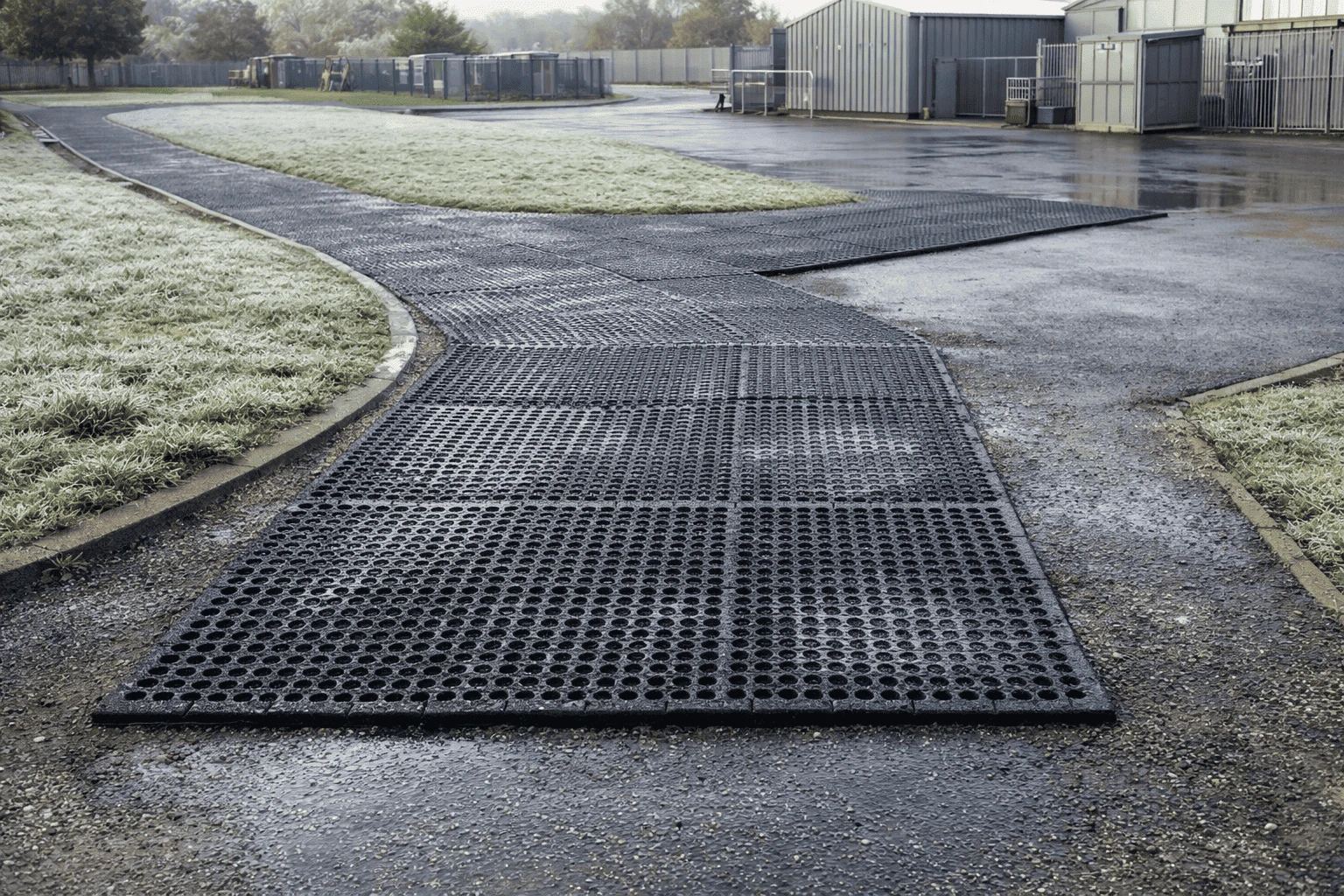
Rubber grass mats are designed to reinforce natural ground while maintaining usability. By distributing load and allowing water to drain through the structure, they help prevent surface erosion and reduce the formation of slippery areas. These mats are particularly suitable for access routes, perimeter walkways, and transitional zones between hard and soft ground.
In many industrial and commercial environments, a consistent footing is critical for safety. Products within the Rubber Grass Mats category are commonly used where surface stability is essential without permanently altering the landscape. Their structure helps create even, predictable surfaces across areas exposed to heavy foot traffic or seasonal weather changes.
In public areas such as schools, parks, or community spaces, reliable surface performance is crucial. Rubber grass mats designed for playgrounds and shared outdoor facilities create stable, impact-absorbing surfaces that remain functional in changing weather conditions.
These applications benefit from materials that can withstand repeated use while maintaining their structural properties. Ensuring even surfaces reduces the likelihood of trips and falls, supporting safer access and helping organisations meet duty-of-care obligations.
Even well-designed matting systems can become hazardous if individual sections move independently. Gaps, raised edges, or misaligned mats are common causes of trips in outdoor environments. A secure connection between mats is therefore essential for maintaining a compliant surface.
Natural rubber floor mat connectors help create a unified flooring system by keeping individual mats aligned. This reduces inconsistencies and supports long-term stability, particularly in areas with frequent pedestrian movement.
In more demanding environments, such as high-traffic access points or exposed outdoor zones, connectors must withstand repeated stress and environmental exposure. Durable rubber connectors designed for outdoor use maintain surface integrity despite weather changes.
By limiting movement and keeping mats aligned, secure connectors reduce foreseeable trip hazards and contribute to compliance with UK safety standards.
Industrial environments require practical flooring solutions that balance safety with durability. Outdoor areas may be used daily and exposed to both foot traffic and environmental wear. Rubber grass mats offer a flexible approach, reinforcing natural ground without the need for permanent surfacing. When combined with secure connectors, these systems maintain level surfaces across large areas, reduce maintenance requirements, and support safer access routes.
Commercial and public environments must accommodate a wide range of users, including children, visitors, and staff. Flooring solutions in these settings should prioritise surface consistency and ease of movement. Rubber matting systems provide a reliable way to manage outdoor surfaces while remaining adaptable to different site layouts. A risk-based approach allows organisations to tailor flooring solutions to specific environments, ensuring that safety measures are proportionate and effective.
Installation quality directly impacts long-term safety. Mats should be laid on a stable, prepared base and fixed securely to prevent shifting. From an inspection perspective, well-installed flooring demonstrates that reasonable steps have been taken to control risks. Inspectors assess both the material and how it is maintained over time. Securely connected matting systems are easier to inspect and less likely to raise compliance concerns.
Outdoor flooring should be inspected regularly, particularly after heavy rain or frost. Early identification of movement or wear helps prevent minor issues from developing into safety hazards. Properly installed and maintained rubber matting systems retain their performance characteristics for longer, supporting consistent compliance and safer pedestrian access.
Outdoor flooring safety is a key element of risk management in industrial and commercial environments. Uneven or unstable surfaces can quickly become a liability, particularly under the UK’s variable weather conditions. Addressing these risks requires solutions that focus on stability, drainage, and long-term surface integrity. Using interconnected matting systems that maintain even surfaces and withstand frequent use helps reduce hazards and supports regulatory expectations.
Ultimately, effective outdoor flooring relies on understanding site-specific risks and implementing proportionate control measures. Organisations that take a considered approach to surface reinforcement and maintenance can create safer, more functional outdoor environments that remain reliable throughout the year. Additional guidance on rubber matting applications and solutions is available at therubbermats.uk.

UK writer Evan covers home improvement, construction, and lifestyle trends, sharing practical insights for readers.
This guide cuts through the noise. Whether you are searching for a baby car seat in Dubai for the fi
7 September 2026
In UK industrial and commercial environments, selecting the right materials is crucial for ensuring
3 February 2026
Slips and trips are among the most common causes of injury in both domestic and commercial environme
30 January 2026
Be the first to share your thoughts
No comments yet. Be the first to comment!
Share your thoughts and join the discussion below.



.webp&w=3840&q=75)