Wednesday, November 25, 2026
* All product/brand names, logos, and trademarks are property of their respective owners.
If you have ever changed hospitals, you know the drill. New clinic, new file, and the same old question: "Do you have your previous reports?" You dig through a bag of printouts, scroll through WhatsApp for a scan, and hope nothing is missing.
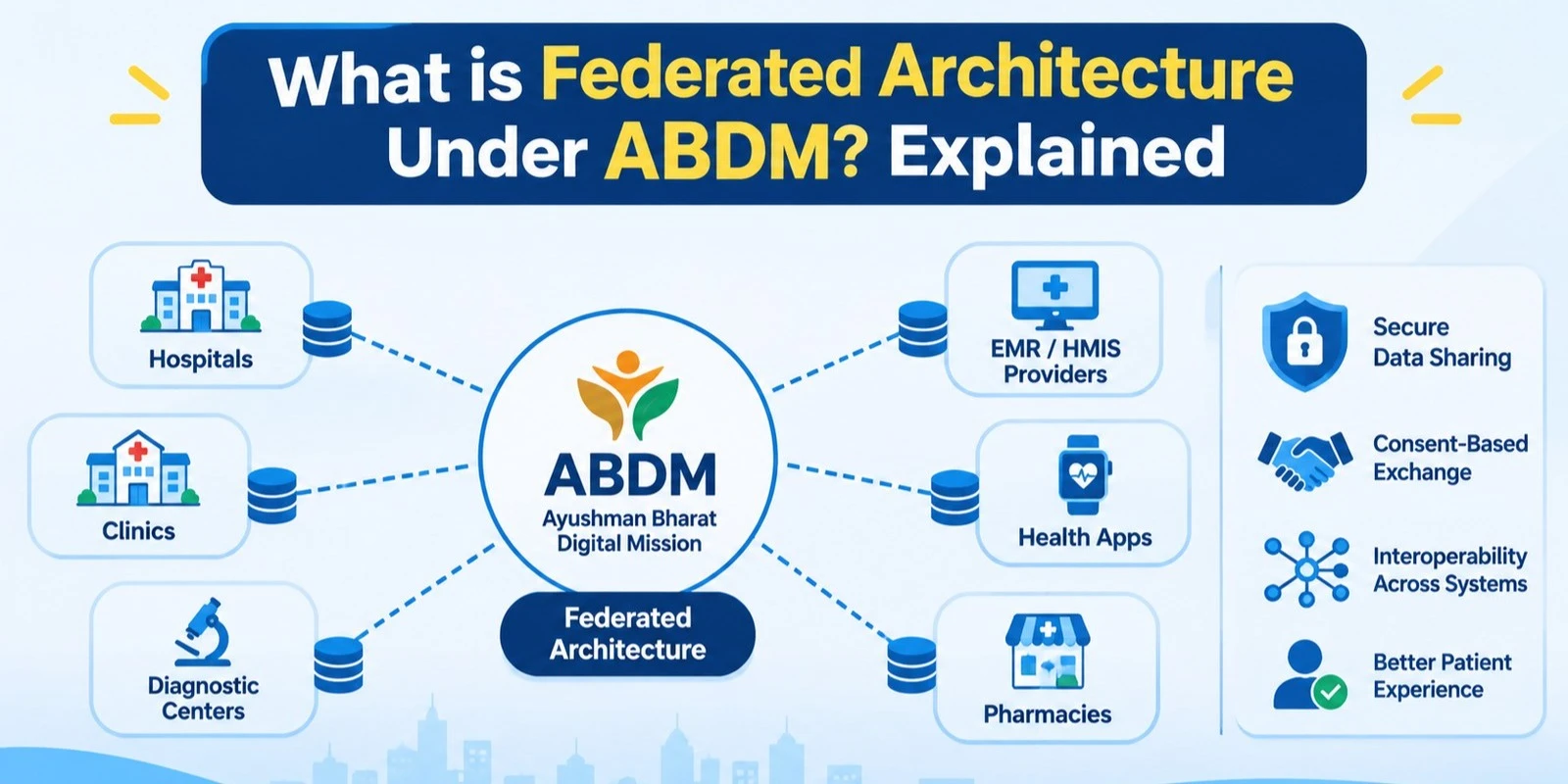
India's Ayushman Bharat Digital Mission (ABDM) is trying to fix exactly this. And the idea at the heart of it is something called federated architecture. The term sounds technical, but the concept is surprisingly simple. This post explains it in plain language: what it is, how it works, and why it matters for patients, doctors and health-tech builders.
The Ayushman Bharat Digital Mission is a national initiative run by the National Health Authority (NHA). Its goal is to build a connected digital health ecosystem where your health records can move safely between hospitals, labs, pharmacies and apps, but only when you allow it.
To make that possible, ABDM provides a few building blocks:
Federated architecture is the design choice that ties all of these together.
In a centralised system, all data is copied into one giant database. Everyone sends their records there, and everyone queries it from there.
In a federated system, the data stays where it was created. Your blood test report remains with the lab that produced it. Your discharge summary stays with the hospital. Instead of moving everything into one place, the system creates a secure network that lets these separate databases talk to each other on request.
A simple analogy: think of a library network. Each library keeps its own books, but a shared catalogue tells you where a book is and lets you borrow it from another branch. ABDM Connector works the same way, except the "books" are your health records and you decide who may borrow them.
Here is the typical flow, step by step.
There are solid reasons behind this choice.
Privacy by design. With no single giant database, there is no single jackpot for attackers. A breach at one provider does not expose the entire country's health data.
Patient control. Consent is built into every exchange. Nothing moves without your approval, which fits well with the principles of India's Digital Personal Data Protection Act, 2023.
Scalability. India has lakhs of facilities, from large corporate hospitals to small rural clinics. A federated model lets each keep its own systems and join the network gradually, rather than forcing everyone onto one platform.
Interoperability through standards. Because records come from different systems, ABDM relies on common standards such as HL7 FHIR for data format and terminologies like SNOMED CT and LOINC, so one system can understand another's data.
Less duplication, lower cost. Providers do not need to re-upload everything to a central server, and patients avoid repeat tests.
For patients: One ID, one place to view records from many providers, and full control over who sees them.
For doctors: A faster, more complete view of a patient's history, which helps with better decisions and fewer repeated investigations.
For hospitals and labs: A way to join a national network without giving up ownership of their data.
For health-tech developers: Open, standards-based APIs and a sandbox environment to build and test apps that plug into the ecosystem.
No system is perfect. Federated architecture depends on providers actually digitising their records and linking them to ABHA. Adoption varies across states and facility sizes, internet connectivity can be patchy in some areas, and awareness among patients is still growing. Data quality also differs from one provider to another. These are real hurdles, and ABDM's rollout is still maturing.
Federated architecture is what makes ABDM different from a plain "national health database." Your records stay where they were created, they travel only with your consent, and they move over secure, standardised channels. For patients, it means control. For providers, it means flexibility. For the country, it means a health system that can finally connect the dots without putting everything in one basket.
If you are a patient, creating an ABHA number is the first step. If you are a provider or developer, the ABDM sandbox is the place to start.

Coffee lovers are changing the way they start their mornings. Instead of relying only on traditional
26 September 2026
An advanced cancer treatment that costs hundreds of thousands of dollars in the United States can, a
22 August 2026
A radiant smile is a powerful asset in your daily life. It significantly boosts your confidence and
11 June 2026
Be the first to share your thoughts
No comments yet. Be the first to comment!
Share your thoughts and join the discussion below.