Monday, October 19, 2026

* All product/brand names, logos, and trademarks are property of their respective owners.
Swimming pools, beaches, lakes, and waterparks can be exciting places for families and communities, but they also require trained professionals who can prevent accidents and respond quickly during emergencies. That is where lifeguards play an essential role.
Many people searching online ask questions such as:
A professional lifeguard class prepares students to protect lives through water rescue training, CPR certification, first aid education, surveillance techniques, and emergency response practice. These courses are designed to teach both prevention and life-saving action.
Unlike a regular swimming lesson, a lifeguard class combines physical endurance, mental focus, leadership, and teamwork. Students learn how to stay calm under pressure while making quick and effective decisions during emergencies.
This guide answers the most common questions about lifeguard classes and explains why proper training is critical for anyone interested in aquatic safety.
A lifeguard class is a professional training course designed to teach individuals how to prevent and respond to aquatic emergencies.
The main goal of a lifeguard class is to prepare students to:
Professional courses are often provided through organizations such as the American Red Cross, American Lifeguard Association, and United States Lifesaving Association.
These organizations follow recognized safety standards to ensure lifeguards receive high-quality training.
Water emergencies can happen in seconds, and untrained individuals may not know how to respond safely.
Without professional instruction, rescuers may:
A professional lifeguard class teaches students how to respond correctly while protecting both the victim and themselves.
Experienced lifeguards understand that preventing accidents is just as important as responding to emergencies.
Lifeguards help prevent:
Professional training helps students recognize problems before they become life-threatening.
Lifeguard classes combine practical rescue training with emergency medical instruction.
Students learn how to rescue swimmers without entering the water whenever possible.
Common rescue tools include:
Throwing assists involve tossing flotation equipment to distressed swimmers from a safe distance.
Training focuses on:
An active victim is conscious but struggling in the water.
Students practice:
Passive victims may be unconscious or unable to assist themselves.
Training includes:
These realistic rescue drills prepare students for real emergencies.
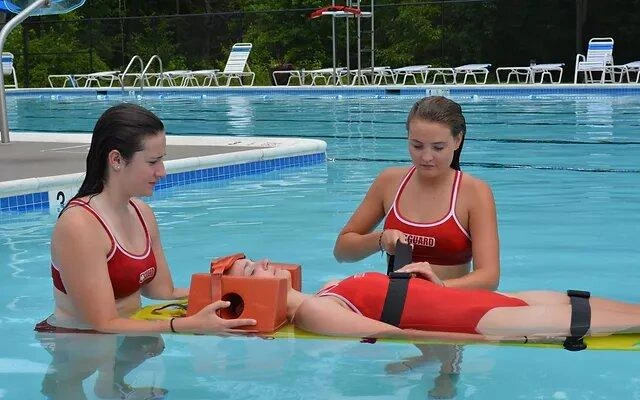
Aquatic spinal injuries require careful handling.
Students learn:
Hands-on practice helps build confidence and accuracy.
Professional lifeguards are often the first responders during emergencies.
Students receive CPR training for:
Instruction includes:
Repeated practice helps students respond effectively during emergencies.
AED stands for Automated External Defibrillator.
Students learn:
Fast CPR and AED use can greatly improve survival chances during cardiac emergencies.
Lifeguard classes teach treatment for:
These medical skills are valuable in both professional and everyday situations.
The best lifeguards stop emergencies before they happen.
Surveillance means continuously watching swimmers and identifying danger quickly.
Students learn how to:
Strong surveillance skills are critical because drowning can happen quietly.
Lifeguards learn how to recognize:
Identifying risks early helps prevent accidents.
Many students underestimate the physical demands of lifeguard training.
Most classes require participants to:
These tests ensure students are physically prepared for emergencies.
Real rescues may involve:
Physical endurance helps lifeguards respond safely and effectively.
Lifeguarding requires more than physical ability.
During emergencies, lifeguards must:
Training scenarios help students improve confidence and decision-making abilities.
Most emergencies involve multiple rescuers working together.
Students practice:
Strong teamwork improves rescue efficiency and safety.
Professional certification opens the door to many job opportunities.
Pool lifeguards commonly work at:
Waterfront lifeguards supervise:
Additional training is often required for open-water environments.
Surf lifeguards work in ocean environments where conditions constantly change.
Training may include:
Surf lifeguarding is highly specialized and physically demanding.
Lifeguard training offers both professional and personal rewards.
Certified lifeguards often enjoy:
Searches for lifeguard jobs near me and summer lifeguard positions continue to grow each year.
Lifeguard classes help students develop:
These transferable skills are valuable in nearly every career field.
Few jobs provide the opportunity to protect lives and support community safety in such a direct way.
Many lifeguards describe the role as both meaningful and highly rewarding.
Not all training providers offer the same quality of instruction.
Important factors include:
Programs associated with organizations like the American Red Cross and American Lifeguard Association are widely respected by employers.
A professional lifeguard class teaches much more than swimming skills. It prepares students to prevent emergencies, perform life-saving rescues, administer CPR, and maintain safe aquatic environments.
Whether you are searching for lifeguard class near me, how to become a lifeguard, or the best lifeguard certification program, professional training is the first step toward a rewarding role in aquatic safety.
Lifeguarding is more than a job it is a responsibility built on preparedness, teamwork, leadership, and the ability to protect lives when every second counts.

Evan Richardson is a certified Aquatic Safety Instructor and experienced lifeguard trainer with over 15 years of experience in water rescue operations, CPR education, and aquatic facility management. He has trained lifeguards across pools, waterfront programs, and recreation centers while promoting professional rescue standards and community water safety awareness.
Choosing the right topic is one of the most important steps when preparing a TEFL assignment. A suit
7 September 2026
Computers have transformed how people learn, work, communicate, and create. Coding plays an importan
25 August 2026
For a long time, the corporate data lifecycle looked like an exclusive, heavily guarded fortress. If
3 July 2026
Be the first to share your thoughts
No comments yet. Be the first to comment!
Share your thoughts and join the discussion below.




.webp&w=3840&q=75)