Saturday, October 10, 2026

* All product/brand names, logos, and trademarks are property of their respective owners.
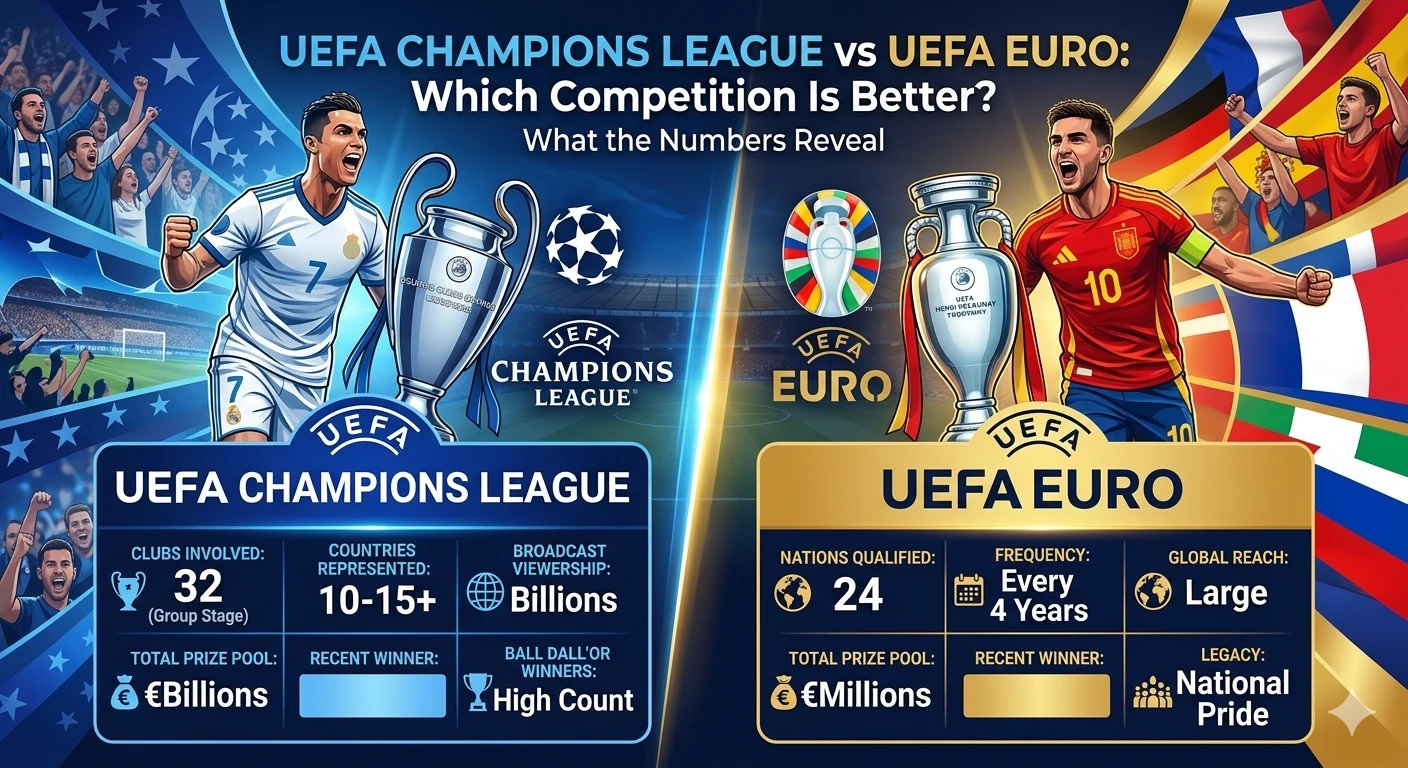
Every few years, football fans find themselves debating one of the sport's most fascinating questions: Is the UEFA Champions League better than the UEFA European Championship?
The UEFA Champions League delivers elite club football week after week, while the UEFA Euro brings together Europe's best national teams in a month-long battle for continental glory.
Both competitions occupy a special place in football culture. Yet they differ dramatically in quality, prestige, audience, and emotional significance.
So which tournament comes out on top? The answer depends on what fans value most.
When it comes to pure footballing quality, many experts believe the Champions League has the edge.
Unlike national team managers, club coaches work with their players daily throughout the season. This allows teams to develop sophisticated tactical systems and stronger chemistry.
Legendary manager Arsène Wenger once noted that club football generally produces a higher technical level because players train together year-round, unlike national teams that gather only a few times each season.
The Champions League also concentrates many of the world's best players into a handful of elite clubs. Teams such as Real Madrid, Manchester City, Bayern Munich, and Paris Saint-Germain often field lineups worth hundreds of millions of euros.
As former manager José Mourinho famously said in interviews over the years, the Champions League represents "the highest level of club football in the world."
However, football is not only about technical quality.
The Euros carry a level of emotional significance that club competitions often struggle to match.
Players represent their countries rather than their employers. Victories become national celebrations, while defeats can haunt generations.
Former England captain Harry Kane described international tournaments as "the pinnacle" for many players because they offer the opportunity to represent an entire nation rather than a club.
For many supporters, the emotional connection to their country outweighs any club allegiance.
The Champions League is one of the most-watched annual sporting competitions in the world.
According to UEFA, the 2024 Champions League final attracted a global live audience exceeding 145 million viewers, with hundreds of millions more consuming highlights and digital content throughout the tournament.
The competition also generates billions of euros in broadcasting and commercial revenue each season, making it one of the richest sporting events on Earth.
Its global appeal stems partly from the concentration of football's biggest stars at Europe's wealthiest clubs.
While the Champions League dominates annually, the Euros often attract larger audiences for individual matches.
UEFA reported that Euro 2024 generated cumulative live television audiences measured in the billions across the tournament. Major knockout matches and the final attracted some of the largest football audiences outside the FIFA World Cup.
The final between Spain and England became one of the most-watched sporting broadcasts of the year across Europe.
This demonstrates a key difference: the Champions League wins in annual consistency, while the Euros benefit from rarity and national passion.
Success in both tournaments can define careers.
The Champions League has crowned legends such as Cristiano Ronaldo, Lionel Messi, and Luka Modrić.
Meanwhile, international tournaments transformed the legacies of players such as Andrés Iniesta and Gianluigi Donnarumma.
Former Manchester United manager Sir Alex Ferguson once described winning the Champions League as the ultimate achievement in club football.
Yet many players have admitted that lifting a trophy with their country produces a unique sense of pride that club success cannot fully replicate.
Former Spain midfielder Xavi Hernández has repeatedly emphasized that international tournaments carry extraordinary pressure because players represent millions of people rather than a club fanbase.
Meanwhile, numerous elite coaches and analysts have argued that the Champions League showcases a higher level of football because of superior tactical preparation and squad quality.
The debate often reflects what individuals value more: quality or emotion.
The statistics suggest the Champions League delivers the highest level of football.
Its clubs spend more money, employ the world's best players, and play together throughout the year. Most analysts consider it the strongest football competition outside the FIFA World Cup.
However, if football is about emotion, national identity, and unforgettable moments, the Euros offer something the Champions League cannot.
The Champions League may provide better football.
The Euros may provide better stories.
And that is why the debate remains impossible to settle completely.
For neutral fans seeking elite quality, the Champions League probably wins.
For supporters dreaming of national glory, the Euros remain unmatched.
Trust is one of the most important factors in the jewellery buying journey. Customers are not simply
6 October 2026
Divicast.com has been linked to websites that offer access to movies and television content through
5 October 2026
In the current digital-first economy, the expectations of customers have risen to new levels. C
11 September 2026
Be the first to share your thoughts
No comments yet. Be the first to comment!
Share your thoughts and join the discussion below.



.webp&w=3840&q=75)