Saturday, October 10, 2026

* All product/brand names, logos, and trademarks are property of their respective owners.
Computers have transformed how people learn, work, communicate, and create. Coding plays an important role in websites, applications, games, robots, and intelligent systems. When students learn programming early, they develop more than coding skills. They learn how to solve problems, organize ideas, test solutions, and turn concepts into working results.
A Coding Olympiad gives students a practical environment to apply these skills through challenges and competition. It encourages learners to think logically, identify mistakes, improve their solutions, and learn through practice.
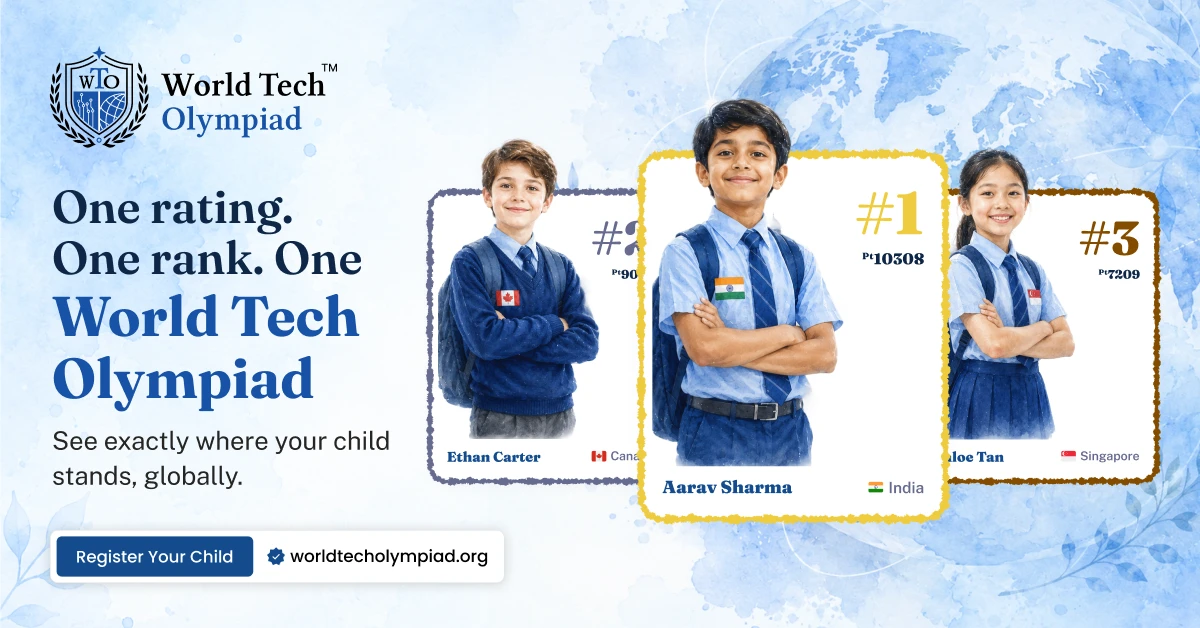
The World Tech Olympiad provides a global technology competition for students from Class 2 to Class 12. Coding is one of its core areas, along with Artificial Intelligence, computational thinking, cybersecurity, and robotics.
A Coding Olympiad is a technology competition that evaluates programming, logic, algorithms, computational thinking, and problem-solving skills.
Instead of only learning concepts in a classroom, students apply their knowledge to solve challenges. Depending on their age and experience, they may work with visual or block-based programming, Python, algorithms, robotics, AI, and other programming concepts.
Coding teaches students a structured way to approach problems. When a program does not work, they need to examine the instructions, identify the issue, and make changes. This process develops patience, analytical thinking, and attention to detail.
Learning coding can help students improve:
These skills can also support learning in subjects beyond computer science.
The World Tech Olympiad (WTO) connects coding with other important areas of technology. Its main technology areas include:
This approach helps students understand how different technology skills work together. Programming can support robotics, algorithms can support AI, and computational thinking can help solve cybersecurity and technology problems.
WTO uses three tracks to match learning with students' age and existing knowledge.
The Foundation level introduces younger students to block-based coding, visual programming, sequencing, patterns, logic, and simple problem-solving. The focus is on making technology understandable and engaging.
The Explorer level introduces more structured programming, including Python fundamentals, algorithms, computational thinking, data concepts, and programming logic.
The Innovator level allows older students to explore advanced concepts such as algorithms, applied AI, machine learning, robotics, cybersecurity, and real-world technology projects.
A Coding Olympiad can help students develop several important technology skills.
Students learn how instructions work together to produce a particular result and understand how changes in logic can affect a program.
Students learn to create logical sequences of steps for solving problems. This becomes increasingly useful as programming challenges become more complex.
Computational thinking helps learners break large problems into smaller parts, identify patterns, organize information, and create logical solutions.
Coding challenges encourage students to understand a problem before trying to solve it, helping them move beyond random trial and error.
Students can apply coding knowledge through games, animations, websites, applications, robotics activities, and other technology projects.
Regularly applying programming concepts can help students become more comfortable with coding.
Competition can motivate students to practice regularly and improve their programming skills.
Students make decisions while solving challenges and learn to evaluate their own solutions.
A competition gives students a clear goal. They can prepare, participate, review their performance, and work toward improvement.
WTO provides persistent skill ratings and global rankings, allowing students to track their progress across editions.
Students can receive verifiable recognition for participation and achievement. WTO includes certificate levels such as Participation, Nationalist, and World Finalist, with unique certificate IDs for verification.
Young students do not need to begin with complicated programming languages. Visual and block-based programming can introduce concepts such as sequencing, patterns, instructions, and basic logic.
As students gain confidence, they can gradually move toward programming fundamentals, Python, algorithms, and advanced technology concepts. The goal is steady progress rather than becoming an expert immediately.
Parents can encourage children to explore coding through the World Tech Olympiad. Parents can support learning by:
Parents do not need programming expertise to create a positive environment for learning.
Schools can use the World Tech Olympiad to provide students with additional opportunities to develop technology skills.
The school program includes tools for enrollment, participation tracking, rankings, and performance reporting. WTO also positions its program as curriculum-aligned with CBSE, ICSE, and CSTA.
Schools can use coding competitions to:
Students can make better progress through regular and focused practice.
Understand concepts such as sequences, instructions, conditions, and variables according to the student's level.
Puzzles, patterns, sequences, and reasoning activities can strengthen skills used in programming.
Start with manageable challenges and gradually increase difficulty.
Programming errors are normal. Students can examine what went wrong and try different solutions.
Creating a small game, animation, website, quiz, or application can make coding more practical.
After developing coding skills, students can explore AI, robotics, cybersecurity, and other technology areas.
A coding course and a Coding Olympiad serve different but complementary purposes. A course usually teaches programming concepts step by step, while an Olympiad gives students an opportunity to apply those concepts through challenges and measure their performance.
Students can learn through courses and practice before using competitions to test their knowledge and identify areas for improvement.
For students who want to continue their technology education, Global Tech Council provides technology-focused courses and certifications in areas such as AI, programming, and emerging technologies.
Coding provides a useful foundation for understanding Artificial Intelligence. AI systems rely on algorithms, data, computation, and programming. Students familiar with programming can later explore machine learning, data science, AI applications, and intelligent systems.
Coding becomes practical when students use it to control physical systems. Robotics activities demonstrate how programming instructions can influence sensors, movements, and automated actions.
WTO's senior Innovator track connects coding with robotics, AI, cybersecurity, algorithms, and real-world projects.
Coding can provide a foundation for several technology fields, including:
Students interested in blockchain and Web3 can explore advanced learning through Blockchain Council, which offers courses and certifications in blockchain and related technologies.
Students interested in business, marketing, or management can explore professional learning opportunities through Universal Business Council.
The World Tech Olympiad connects learning, practice, competition, and recognition. Students can use the experience to:
The competition also includes online editions, allowing students to participate remotely.
A Coding Olympiad is suitable for students who enjoy technology, puzzles, programming, AI, robotics, mathematics, or logical challenges. Students can develop coding and problem-solving skills progressively without needing to be expert programmers.
Coding helps students develop problem-solving, logical thinking, and creativity. A Coding Olympiad allows them to apply these skills through competition and learning. The World Tech Olympiad connects coding with AI, robotics, cybersecurity, and computational thinking, helping students prepare for a technology-driven future.
A Coding Olympiad is a student competition that tests programming logic, computational thinking, coding knowledge, algorithms, and problem-solving skills.
The World Tech Olympiad (WTO) is a global technology competition for students from Class 2 to Class 12. It covers coding, AI, computational thinking, cybersecurity, and robotics.
Yes. Younger learners can start with visual and block-based coding, while older students can explore Python, algorithms, AI, robotics, and advanced concepts.
Students from Class 2 to Class 12 can participate through the Foundation, Explorer, and Innovator tracks.
Students can develop programming logic, computational thinking, Python fundamentals, algorithms, problem-solving, and project-based coding skills.

No bio available yet.
Choosing the right topic is one of the most important steps when preparing a TEFL assignment. A suit
7 September 2026
For a long time, the corporate data lifecycle looked like an exclusive, heavily guarded fortress. If
3 July 2026
Brazil is one of the most successful and respected football nations in history. The South American p
16 June 2026
Be the first to share your thoughts
No comments yet. Be the first to comment!
Share your thoughts and join the discussion below.










.webp&w=3840&q=75)